

DMX512 (abbreviated as DMX) is a globally recognized digital control protocol in the professional lighting field. It was initially developed for theatrical stage lighting.
Each channel of this protocol supports precise dimming from 0 to 255 levels, enabling smooth color grading, brightness gradients, and scene calls. It is widely compatible with various types of lighting fixtures such as LED decoders, wall wash lights, linear lights, flexible neon lights, and moving head lights.
Traditional XLR wired DMX is stable and reliable in small areas, but it has shortcomings when dealing with large-scale. Scattered project sites: short transmission distance, limited number of channels per line, and difficulty in achieving signal backup.
This article summarizes the application of controllers based on different project scenarios, combined with the advantages of control way.
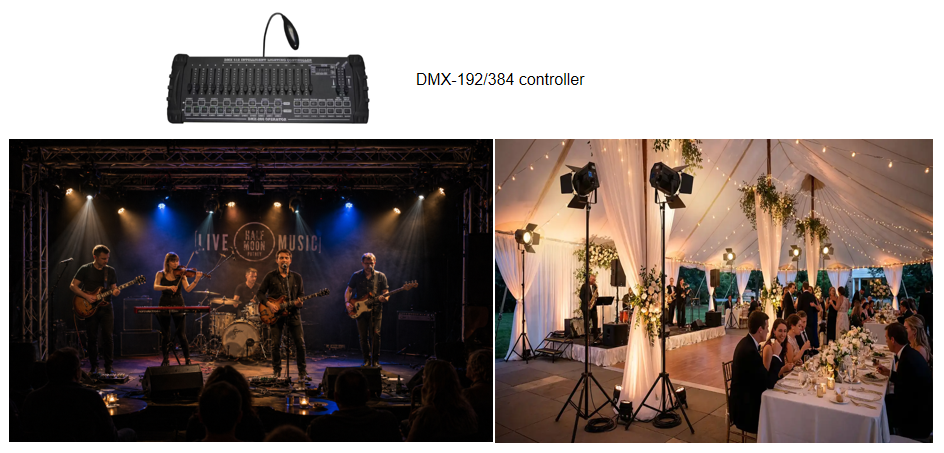
Bar, clubs, or small stages
DMX-192/384Operator
DMX-192/384 operator uses the DMX512 protocol, the industry standard for controlling stage lighting and effects .This is a compact console for small to medium setups, ideal for controlling moving heads, wash lights for small pace lighting control.
Large theaters/Concerts
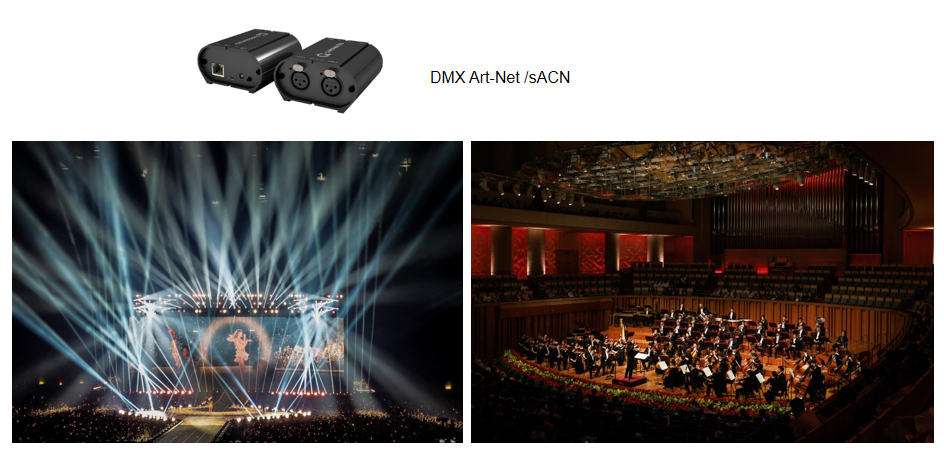
DMX Art-Net/sACN:DMX data is encapsulated into Ethernet data packets and transmitted using ordinary network cables / optical fibers.
DMX512 was created specifically for stage lighting, standard universal interfaces. It supports almost all professional lamps, LED controllers, moving lights, strobe lights, flicker lights, LED light strips, and engineering decoders for projects.
Concerts often involve hundreds of moving lights, LED screens, LED wall lights, LED neon lights. Each single lamp requires tens to dozens of DMX channels. Then the total channels can reach tens of thousands, far exceeding the capacity of a single DMX line.
Art-Net/sACN can easily carry hundreds of Universes through the network.
Stage lighting is dispersed: stage front light, side light, top light, ground lighting, truss lighting, audience seat lighting. The positions are scattered.
Fiber optic transmission has almost no distance limitations, and the nodes output DMX locally without having to pull long XLR signal cables.
Additionally,music, video, and lighting effects are precisely synchronized. And the time of the lights, LED large screens, and video servers is aligned.
Small-scale building lighting
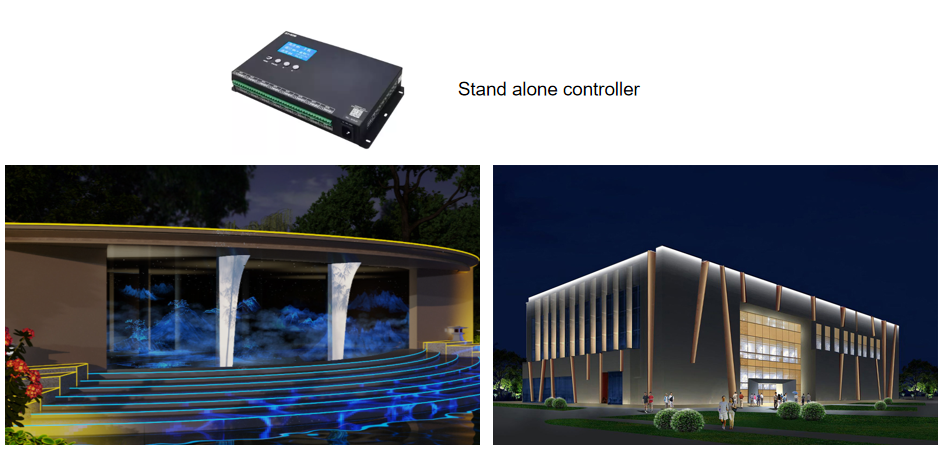
Stand alone controller for small scale DMX control with cost-effective way.
The exterior facades of small buildings are mostly composed of ordinary constant-voltage RGB/RGBW light strips, neon lights, and linear lights (without built-in DMX circuits);
Independent decoders are installed nearby in the weak current box, converting the DMX signals into PWM power drivers,supporting less than 100m data transmission This approach offers higher cost-effectiveness, simpler maintenance, and flexible choosing lamps,suitable for small-scale projects.
Conference/Exhibition/Lobby
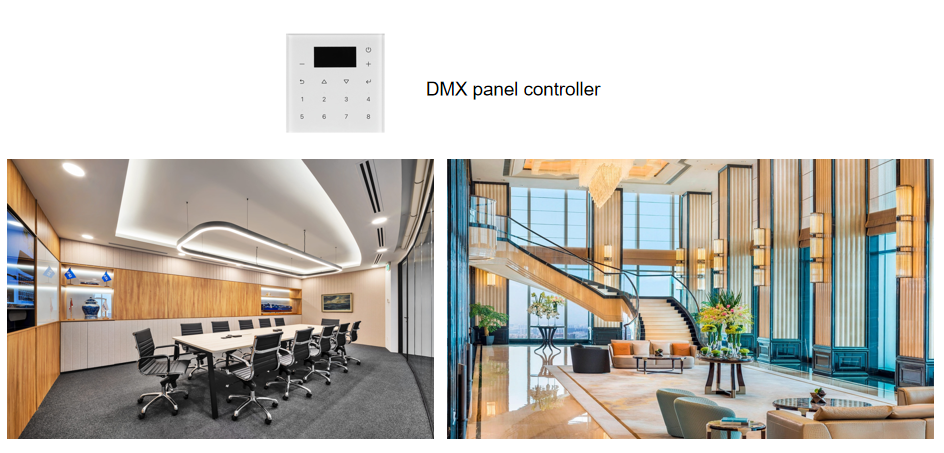
DMX panel controller is easy to handle for specific control.
-Pre-set scenes: Conference presentation, discussion mode, exhibition reception, night duty, cleaning mode, welcome atmosphere, etc. Can be called up with one click, without the need to adjust channels or color values.
– Hotel front desk staff, event staff, exhibition reception staff, no need to understand DMX address codes or channels. There will be no accidental operation that damages the lighting effect.
– Customizable panel text icons: Presentation / Welcome / Night / Clean.
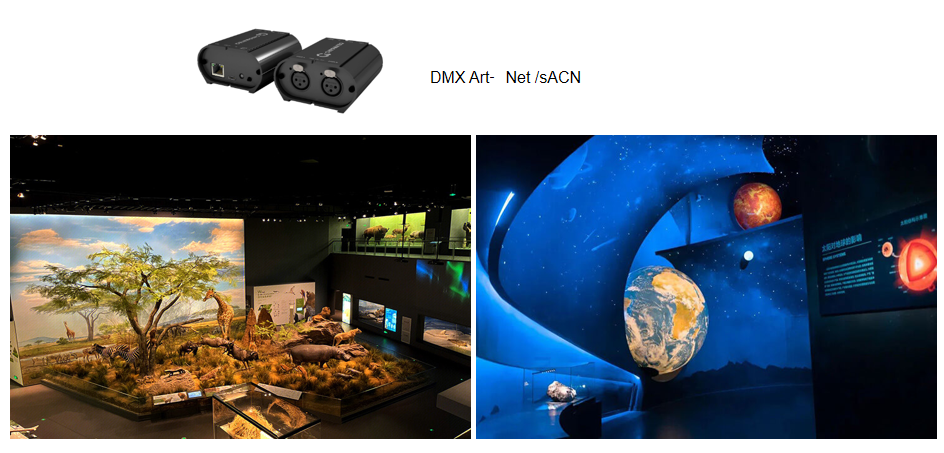
Museum lighting
The Art‑Net/sACN network can integrate multiple exhibition halls into a unified lighting network.
A museum is not merely about turning on the lights. It involves precise light control, conservation of cultural relics, multi-scenario switching, safety redundancy, and centralized system management. There are large and medium-sized museums with color wall washing, zone-specific exhibit lighting, and timed exhibition switching. They generally use Art‑Net / sACN network DMX for large areas, while smaller exhibition areas use local DMX.
The display is extremely sensitive to light intensity and illumination gradient.
The DMX single-channel supports 0-255 level continuous dimming, allowing for very soft fade-ins and fade-outs without stroboscopic effect (with a high-quality DMX decoder and constant current drive), avoiding sudden bright-dark changes in the light that could shock the exhibits.
Pre-store multiple sets of lighting scenes: daily visits, closed-circuit duty, cleaning mode, cultural relic restoration mode, minimum night duty illumination, temporary special exhibition mode.
Switch the entire exhibition hall lighting with one click, and different exhibition areas can be independently called. When changing exhibits, engineers can directly modify the DMX scene without having to reconfigure the hardware wiring on site.
Large-scale lighting projects,Light show
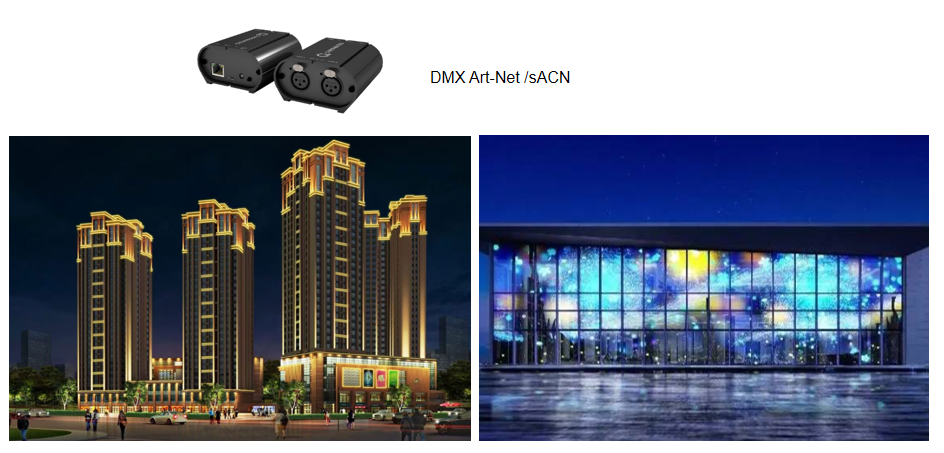
Art-Net/sACN packages DMX for network transmission, solving the bottleneck of traditional DMX wiring.
The characteristics of urban multi-building lighting are numerous lighting points, scattered buildings, cross-regional, long-distance optical fiber transmission, and city-wide coordinated light show. While retaining the mature DMX lighting ecosystem, facilitating the simultaneous playback of light show programs for multiple buildings.
The lighting host is equipped with a time schedule: automatically switch modes on weekdays, weekends, and holidays; automatically turn on and off lights at set times, saving energy consumption.
It can be connected to the smart city platform and building BMS: remote status monitoring, lamp fault feedback, remote one-click start and stop.
Bridge lighting, landscape gardens,Globally Synchronized Displays
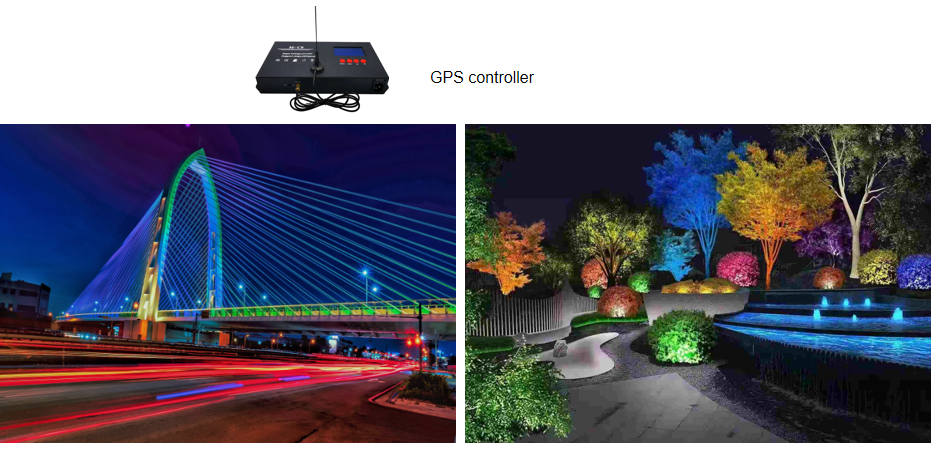
GPS DMX is used to solve projects where it is impossible to lay a main fiber optic cable.
GPS only provides satellite timing (uniform timestamp, millisecond-level synchronization). Lighting animations and channel output still use DMX512. The controller stores programs locally on an SD card, and each point plays independently. The animations are aligned with the global time provided by GPS, and there is no need for fiber/wire interconnection between controllers.
Core pain points for applicable scenarios: rivers, long bridges, river-side landscapes, scattered gardens, across lakes and rivers, the excavation and wiring process is extremely difficult and costly.
Therefore, different transmission and control schemes were derived from DMX. DMX remained the underlying universal language, while ArtNet, sACN, GPS synchronous DMX, DMX wall panels, and independent DMX decoders were respectively tailored to meet the requirements of different projects. The choice of the solution was made based on specific circumstances, considering distance, control requirements, and cost.