

When planning DMX / ArtNet pixel lighting projects, Pixel, Universe and Channel are the most frequently misunderstood terms. Many engineers get confused why one controller port can drive 1024 pixels while a classic DMX line only supports ~170 RGB pixels. This article clarifies definitions, calculations and common pitfalls for addressable LED strips, flexible neon and pixel lighting installations.
Q1: What is universe, channels,pixels
Universe: A Universe is a container holding maximum 512 DMX channels. This is a fixed limit defined by DMX512 protocol.
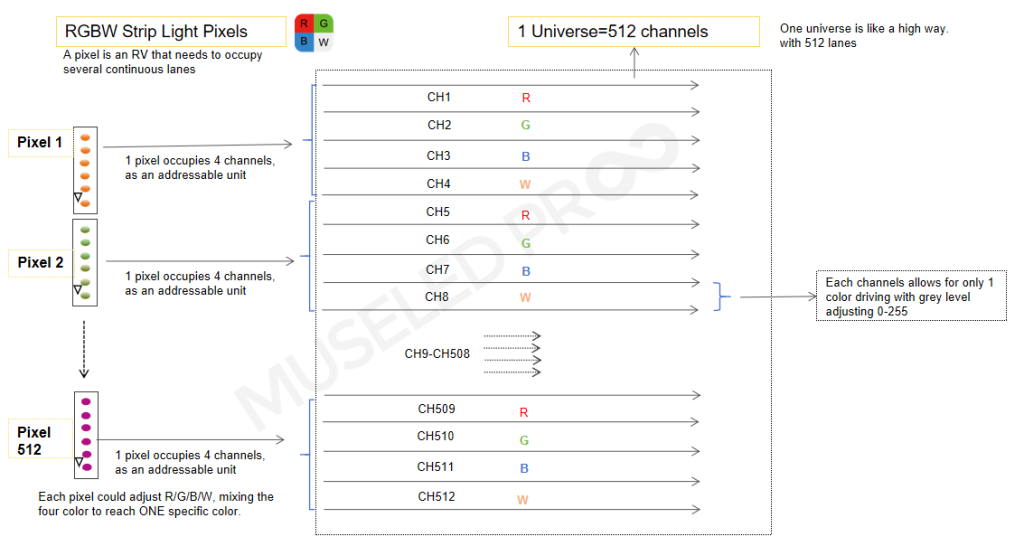
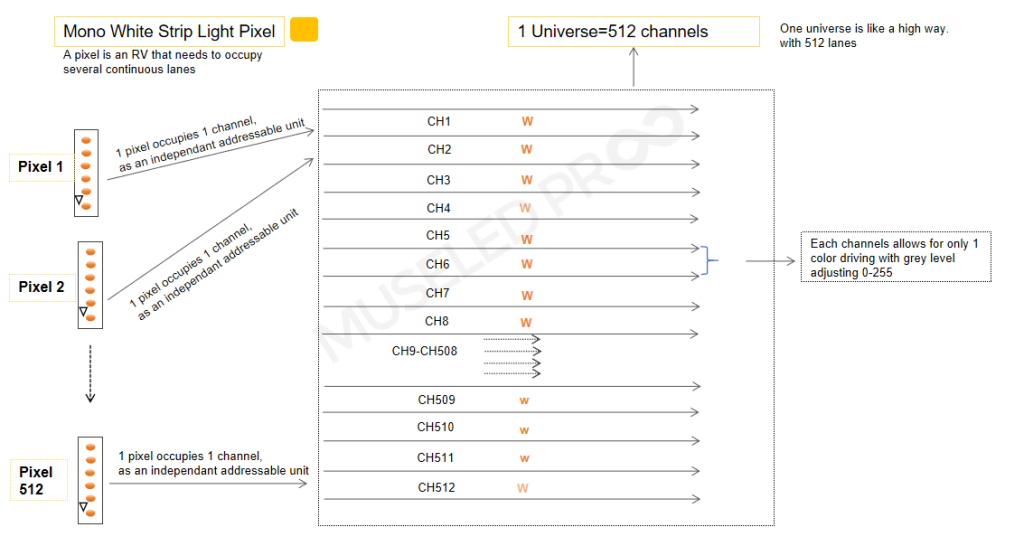
Channels: One DMX channel carries one 8-bit dimming value (0–255). Each channel controls brightness for one single color.
Pixels: A pixel is an individually addressable lighting unit that can change color independently from other pixels.
Think of a Universe as a highway, channels as individual lanes on that highway. A pixel is an RV that needs to occupy several continuous lanes. An RGB pixel RV takes 3 lanes; an RGBW pixel RV takes 4 lanes. One highway (1 universe) only has 512 lanes total. Once all lanes are occupied, you need to open another highway (new universe).
Mono white strip: 1 channel per pixel, a universe support max 512 pixels.
RGB strip: R/G/B,3 channels per pixel,a universe support max 170 pixels.
RGBW strip: R/G/B/W ,4 channels per pixel, a universe support max 128 pixels.
Q2: How to calculate how many universes my project needs
1-Count total pixels
2-Multiply pixels × channels per pixel (3 for RGB / 4 for RGBW)
3-Divide total channels by 512, round up to full universe.
Example: 200 RGBW pixels
Total channels = 200 × 4 = 800 channels
800 ÷512 = 1.57,Need 2 universes
Universe 1: 512 channels (first 128 pixels)
Universe 2: remaining 288 channels (next 72 pixels)
Q3: Are R, G, B, W channels equal in size?
Each channel controls brightness for one single color. R, G, B and White each consume one independent DMX channel, same size and same data range.
Q4: Can we say one IC = one pixel?
For most WS2811, WS2812B, SK6812 pixel strips and digital neon: one IC controls one pixel. But not always 1:1. Some designs use one IC to drive multiple LED chips but still count as one pixel. Rare high-end ICs can drive 2 independent pixels from one chip. Rule: Pixel = addressable unit, not LED chip count, not IC count.
Q5: Why some controller ports can drive 1024 pixels on a single output port?
This is the biggest misconception in DMX pixel projects. That port is an SPI pixel output port, NOT a standard DMX RS485 port. ArtNet / sACN network pixel controllers receive multiple universes via Ethernet, merge those universe data inside the controller chip, then convert all data into a single SPI data stream to the LED strip. So physically one SPI terminal can carry data from 2,4,6 or more universes, which enables driving high pixel numbers like 1024 pixels per port.
Q6:Can one single controller output port handle multiple universes?
SPI pixel output port (ArtNet/sACN controller): YES. Most mid-to-high end ArtNet pixel controllers support mapping multiple universes to one SPI port. The controller internally merges universes and outputs SPI pixel signal.
Standard XLR DMX (RS485) port: NO. A classic DMX cable / XLR port only transmits one universe (512 channels). It cannot pack multiple universes on the same DMX bus.
Q7: What is the difference between DMX signal and SPI pixel signal?
DMX512 (RS485 / XLR): DMX channels data, max 512 channels per universe, used for conventional DMX fixtures and decoders.
SPI signal (WS281x, SK6812): Pixel data stream. SPI is the signal sent directly to LED pixel ICs. SPI ports can carry merged data from multiple DMX universes inside the ArtNet controller.
This guide explains DMX pixels, channels and universes with a highway analogy. One universe has 512 channels, and each pixel uses multiple channels based on RGB/RGBW. Unlike XLR DMX ports limited to one universe, ArtNet SPI outputs merge multiple universes to support more pixels. Accurate universe calculation prevents flicker and sync issues.